
Efforts to Improve Learning Outcomes on Units of Length through Contextual Teaching and Learning (CTL) Assisted by Concrete Media in Elementary Schools
Keywords:
contextual teaching and learning, concrete media, units of lengthAbstract
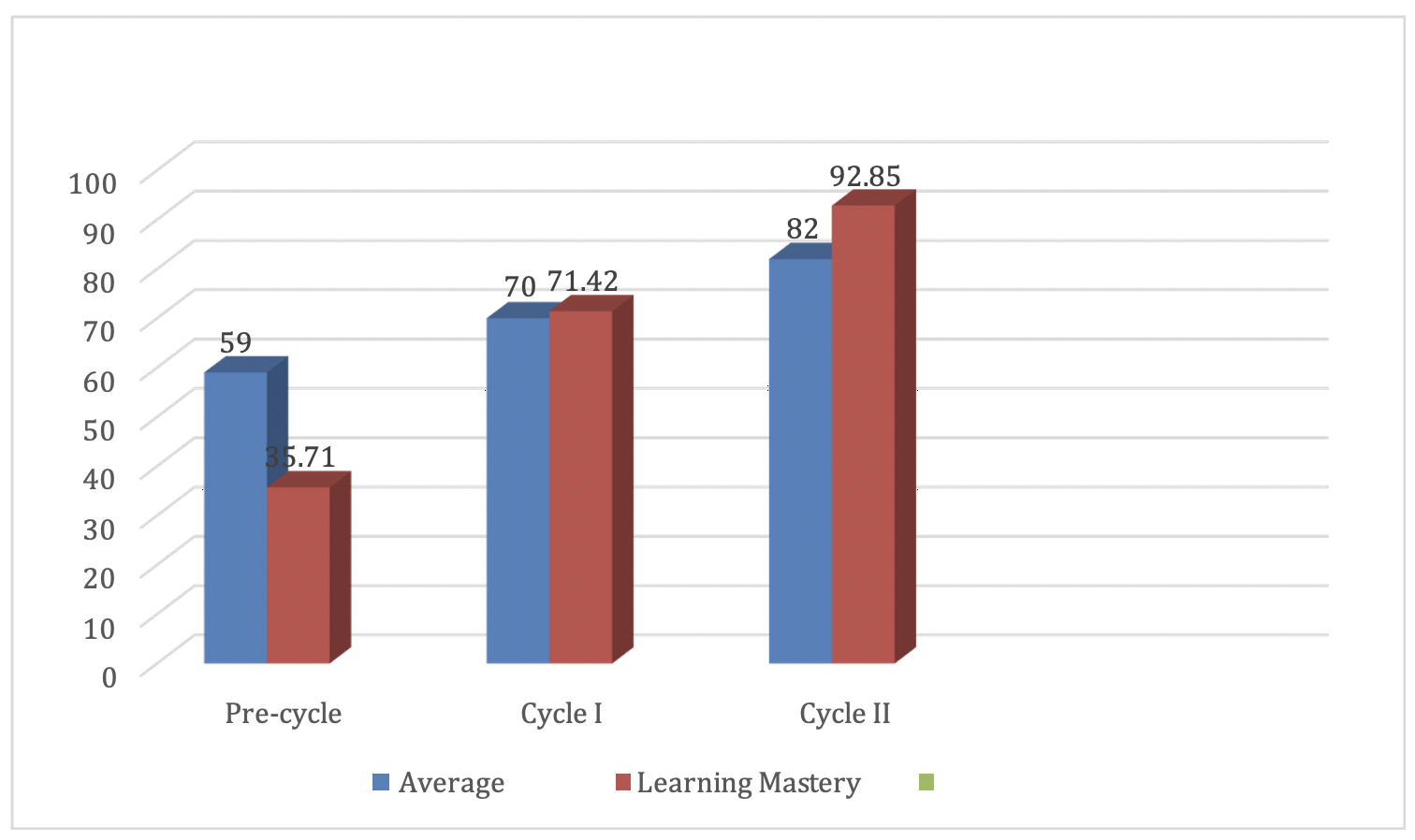
The Contextual Teaching and Learning (CTL) learning model is a learning model oriented toward real-world learning that is familiar in everyday life. Understanding mathematical concepts requires students to use critical, creative, and collaborative thinking skills to solve problems in a focused manner. One such learning model is CTL assisted by more concrete media to introduce units of length. This study aimed to improve learning outcomes in measuring units of length. Through the application of the Contextual Teaching and Learning (CTL) model, assisted by concrete media, students' ability to measure objects correctly can be improved. This study was based on Classroom Action Research (CAR) to improve teacher performance in implementing the learning process. The study was conducted in four stages—planning, implementation, observation, and reflection—repeated over two cycles. The study involved 14 students, consisting of 8 boys and 6 girls. The results showed a significant improvement in student learning outcomes. In the pre-cycle learning, the average learning outcome score was 59; after the intervention, the average score became 70, and in Cycle II it became 82. Classical mastery also increased. In the initial learning, 35% of students achieved mastery; in Cycle I, this increased to 10 students (71.42%), and in Cycle II to 13 students (92.85%). The conclusion of this study concludes that the application of the CTL model assisted by concrete media develops logical, critical, and systematic thinking skills in measuring objects, which contributes to improved student learning outcomes.
References
Al-Tabany. (2017). Mendesain Model Pembelajaran Inovatif, Progresif, Dan Konteksual. Surabaya : Prenada Media.
Apriliyani, W., Sessu, A., & Miatun, A (2023). Upaya meningkatkan kemampuan berpikir kritis siswa pada materi bentuk aljabar melalui pendekatan contextual teaching and learning (CTL) berbantu software algebrator di kelas VII-3 SMP nNegeri 18 kota Tangerang Selatan. Euclid, Vol. 7(2), pp. 77- 147.
Ben Harnis. (2021). Upaya Meningkatkan Hasil Belajar Matematika Soal Cerita Melalui Pendekatan Contextual Teaching And Learning (CTL) Pada Siswa Kelas III UPT. SD Negeri 21 Limo Kaum. Jurnal Ensiklopedia Education Review. Vol. 3(1), hal 87-96
Lestari, W.P., Ningsih, E.F., Choirudin... et al (2023). Efektivitas Model Pembelajaran Kooperatif Dengan Pendekatan Contextual Teaching and Learning (CTL) Terhadap Hasil Belajar Matematika. Jurnal Penelitian Tindakan Kelas. vol. 1(1), pp. 28-33.
Limbong, S. (2022). Model Pembelajaran CTL Dan RME Terhadap Hasil Belajar Matematika Siswa. Medan: Guapedia.
Muhsetyo, dkk., (2021). Pembelajaran Matematika SD. Tangerang Selatan: Universitas Terbuka.
Nur Afifah, D.S., Patmalasari, D, & Nafi’an, N.I. (2018). Tingkat Kreativitas Siswa SD yang Memiliki Disposisi Matematis Rendah Dalam Memecahkan Masalah Matematika. Jurnal Pendidikan. Vol. 7(2), hal 71-76.
Pratiwi, V & Octaviana, A.M. (2024). Inovasi Pembelajaran Matematika: Pendekatan Contextual Teaching and Learning (CTL) Berbantuan Media Konkret untuk Siswa Kelas 2. Jurnal Mutiara PGSD Vol. 1(1), hal 19-29.
Rahmawati et al., (2025). Media Pembelajaran. Padang: CV. Gita Lentera.
Sugiharto. (2022). Contextual Teaching and Learning (CTL). Pekalongan: CV. Mune.
Yunus, M., dkk (2021). Pedoman Karya Tulis Ilmiah. Tangerang Selatan: Universitas Terbuka.
Downloads
Published
Issue
Section
License
Copyright (c) 2025 Sudarmi Silalahi, Mulin Nu’man, Ira Arini (Author)

This work is licensed under a Creative Commons Attribution-ShareAlike 4.0 International License.


