The Use of STEAM in Mathematics Education: A Systematic Literature Review
Keywords:
Mathematics learning, STEAM education, systematic literature reviewAbstract
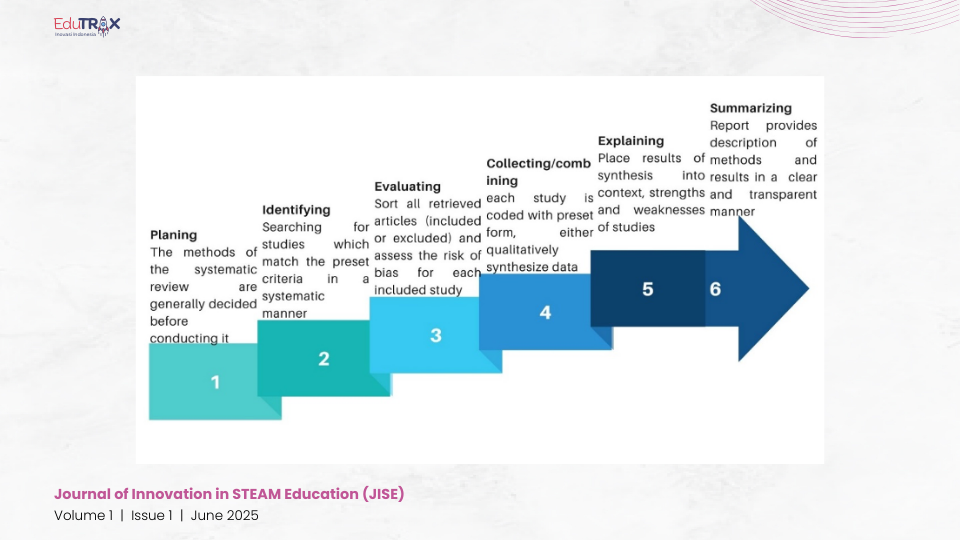
Dynamic changes in the world of education demand the implementation of innovative learning approaches, which are not only oriented towards knowledge transfer but also develop 21st-century skills such as critical thinking, creativity, collaboration, and communication. One approach that has received wide attention in the last two decades is the STEAM (Science, Technology, Engineering, Arts, and Mathematics) approach. This study aims to examine the application of the STEAM approach in mathematics education. The method used is a Systematic Literature Review (SLR) of 302 scientific articles published between 2020 and 2025. The articles were obtained from the Google Scholar and Scopus databases using strict inclusion and exclusion criteria and following the PRISMA selection process. The findings indicate that the STEAM (Science, Technology, Engineering, Arts, and Mathematics) approach generally enhances students' motivation and engagement in the mathematics learning process. However, several challenges were identified, such as limited teacher training and insufficient facilities to support interdisciplinary integration. Based on these findings, the study recommends the need for ongoing training for educators and the development of a structured STEAM curriculum to promote more innovative and transdisciplinary mathematics learning.
References
Boonchom, K., Santi, K., & Sholeh, S. M. (2020). An Investigation of Indonesian In-Service Mathematics Teachers ’ Perception and Attitude Toward STEAM Education An Investigation of Indonesian In-Service Mathematics Teachers ’ Perception and Attitude Toward STEAM Education. Journal of Physics: Conference Series, 1–12. https://doi.org/10.1088/1742-6596/1776/1/012021
Cudero, D. M., Cid-cid, A. I., & Guede-cid, R. (2024). Analysis of mathematics education from a steam approach at secondary and pre-universitary educational levels: a systematic review. Journal of Technology and Science Education, 14(2), 507–528. https://doi.org/https://doi.org/10.3926/jotse.2349
Haas, B., Lavicza, Z., Houghton, T., & Kreis, Y. (2023). Can you create? Visualising and modelling real-world mathematics with technologies in STEAM educational settings. Current Opinion in Behavioral Sciences, 52(January 2022), 101297. https://doi.org/10.1016/j.cobeha.2023.101297
Körtesi, P., Simonka, Z., Szabo, Z. K., & Guncaga, J. (2022). Challenging Examples of the Wise Use of Computer Tools for the Sustainability of Knowledge and Developing Active and Innovative Methods in STEAM and Mathematics Education. Sustainability (Switzerland), 14(12991), 1–23. https://doi.org/10.3390/su142012991
Land, M. H. (2013). Full STEAM Ahead : The Benefit f s of Integrating the Arts Into STEM. Procedia - Procedia Computer Science, 20, 547–552. https://doi.org/10.1016/j.procs.2013.09.317
Ortiz, Z., José, L., Diego, M., Zsolt, M., & Teresa, L. (2023). Teacher growth in exploiting mathematics competencies through STEAM projects. ZDM – Mathematics Education, 55(7), 1283–1297. https://doi.org/10.1007/s11858-023-01528-w
Pahmi, S., Juandi, D., & Sugiarni, R. (2022). The Effect of STEAM in Mathematics Learning on 21st Century Skills : A Systematic Literature Reviews. Prisma, 11(1), 93–104. https://doi.org/DOI: https://doi.org/10.35194/jp.v11i1.2039
Pant, B. P., Luitel, B. C., & Shrestha, I. M. (2020). Incorporating STEAM Pedagogy in Teaching Mathematics. International Conference to Review Research in Science, Technology and Mathematics Education, January 3-6, 319–326
Parker, R., & Sikora, L. (2022). Literature Reviews: Key Considerations and Tips From Knowledge Synthesis Librarians. Journal of Graduate Medical Education, 14(1), 32–35. https://doi.org/DOI: http://dx.doi.org/10.4300/JGME-D-21-01114.1
Paula, L., Rodrigues-silva, J., & Alsina, A. (2021). Brazilian and Spanish Mathematics Teachers ’ Predispositions towards Gamification in STEAM Education. Education Sciences, 11(618), 1–17. https://doi.org/https://doi.org/10.3390/educsci11100618
Prabowo, Y., Rozhana, K. M., Wicaksono, A. A., Sugiharto, F. B., & Maharjan, K. (2024). STEM to STEM : Integrating Applied Mathematics with Visual Arts to Enhance Creative Thingking in Higher Education. Journal of Social Science Utilizing Technology, 2(4), 584–594. https://doi.org/https://doi.org/10.70177/jssut.v2i4.1615
Remijan, K. W., & Township, O. F. (2017). The Interdisciplinary Journal of Problem-based Learning VOICES FROM THE FIELD Project-Based Learning and Design-Focused Projects to Motivate Secondary Mathematics Students. Interdisciplinary Journal of Problem-Based Learning, 11(1). https://doi.org/https://doi.org/10.7771/1541-5015.1520
Xiao, Y., & Watson, M. (2019). Guidance on Conducting a Systematic Literature Review. Journal of Planning Education and Research, 39(1), 93–112. https://doi.org/10.1177/0739456X17723971
Muzakkir, Zulnaidi, H., & Abd Rauf, R. A. (2024). Mathematics module based on STEAM and Quranic approach: A study for student’s perception. Journal on Mathematics Education, 15(2), 363–384. https://doi.org/10.22342/jme.v15i2.pp363-384
Susanto, E., Susanta, A., Rusnilawati, & Ali, S. R. B. (2024). Developing STEAM-Teaching Module in Supporting Students’ Literacy Ability in Elementary School. Mathematics Education Journal, 18(3), 349–366. https://doi.org/10.22342/jpm.v18i3.pp349-366
Downloads
Published
Issue
Section
License
Copyright (c) 2025 Yunita Asmara Dewi, E.I Pusta Siligar (Author)

This work is licensed under a Creative Commons Attribution-ShareAlike 4.0 International License.