Implementing STEM Learning Using Student Worksheets on the Topic of Fraction Subtraction in Elementary Schools
Keywords:
STEM learning, student worksheet, fraction subtraction, engineering design process, realistic mathematics educationAbstract
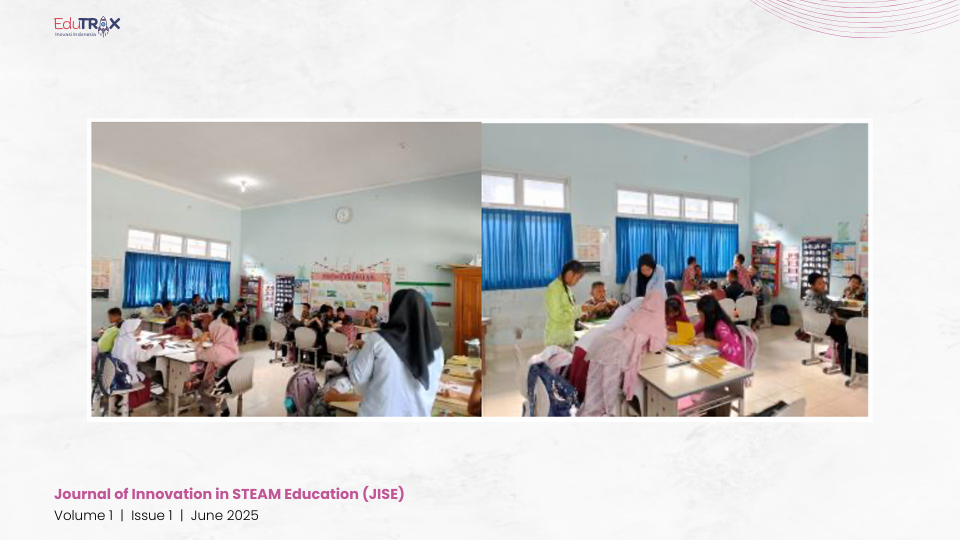
Learning mathematics in elementary schools, particularly regarding fraction subtraction, is a challenge for both teachers and students. The purpose of this study was to describe students' EDP (Engineering Design Process) activities through the Implementation of Student Worksheets (LKPD) based on Indonesian Realistic Mathematics Education (PMRI) and the STEM (Science, Technology, Engineering, and Mathematics) approach, with the support of Artificial Intelligence (AI) on the concept of reducing fractions in elementary schools. The subjects in this study were fifth-grade students of SD Negeri 158 Palembang. The observation technique of document study of students' EDP activities in the implementation of LKPD based on PMRI and the STEM approach, with the support of AI, was categorised as good. It is recommended that the development of STEM-based Student Worksheets (LKPD) be continuously improved by taking into account the characteristics of students and the context of everyday life, so that the material on reducing fractions can be understood in a meaningful way.
References
Arikunto, S. (2013). Prosedur Penelitian: Suatu Pendekatan Praktik. Jakarta: Rineka Cipta.
Bybee, R. W. (2013). The Case for STEM Education: Challenges and Opportunities. NSTA Pres.
Efriani, A. (2025). Playing with balloons as a context for learning measurement based in STEM: What’re the expert think about. Proceedings of the 6th Sriwijaya University Learning and Education International Conference 2024 (SULE-IC 2024), 915, 368–377.
Hidayati, N. (2020). Penerapan Model Pembelajaran Aktif untuk Meningkatkan Minat dan Hasil Belajar Matematika. Jurnal Pendidikan Dasar 8(2), 112-120.
Holmes, W., Bialik, M., & Fadel, C. (2019). Artificial Intelligence in Education: Promises and Implications for Teaching and Learning. Center for Curriculum Redesign.
Luckin, & Forcier, L. B. (2016). Intelligence Unleashed: An Argument for AI in Education. Pearson Education.
Nasution, M. K., & Suryani, N. (2020). Penerapan Model Pembelajaran STEM Berbasis Engineering Design Process untuk Meningkatkan Kemampuan Pemecahan Masalah Siswa. Jurnal Pendidikan Sains Indonesia (Indonesian Journal of Science Education) 8(1), 46–54.
Nugraha, R. A., Yuliati, L., & Supriyatno, T. (2022). Implementasi LKPD berbasis STEM untuk meningkatkan keterampilan pemecahan masalah siswa. Jurnal Pendidikan Sains.
Prastowo, A. (2015). Panduan Kreatif Membuat Bahan Ajar Inovatif. Yogyakarta: DIVA Press.
Sa’dijah, C. (2019). Pembelajaran Matematika Realistik dalam Konteks Kurikulum 2013. Universitas Negeri Malang.
Sugiyono. (2017). Metode Penelitian Pendidikan: Pendekatan Kuantitatif, Kualitatif, dan R&D. Bandung: Alfabeta.
Suryani, N., & Zulkardi. (2020). Hambatan guru dalam mengimplementasikan pendekatan PMRI di sekolah dasar. Jurnal Pendidikan Matematika 14(2), 97-108.
Suyitno. (2018). Media Pembelajaran Matematika di Sekolah Dasar. Yogyakarta: Deepublish.
Van den Heuvel-Panhuizen, M. (2010). Realistic Mathematics Education: A Paradigm Shift in Mathematics Teaching. Educational Studies in Mathematics 73(2), 201-220.
Widodo, S. A., & Ikhwanudin, T. (2020). Contextual teaching and learning (CTL) approach to improve mathematical learning outcomes. Infinity Journal 9(2), 251-258.
Wijaya, A. (2012). Educational research in realistic mathematics education. Utrecht University.
Widjayanti, W., & Jailani, J. (2019). Pengembangan Lembar Kerja Peserta Didik berbasis Pendidikan Matematika Realistik Indonesia untuk meningkatkan kemampuan pemahaman konsep. Jurnal Riset Pendidikan Matematika 6(1), 100-111.
Yuliani, K. S., & Saragih, S. (2015). The development of learning devices based on realistic mathematics education to improve students’ mathematical problem-solving ability and self-efficacy. International Journal of Education and Research.
Yusuf, S. (2020). Peran Teknologi dalam Pembelajaran Matematika di Sekolah Dasar. Jurnal Pendidikan Dasar.
Zulkardi & Putri, R. I. I. (2010). Pengembangan Pembelajaran Matematika Realistik Indonesia (PMRI). Prosiding Seminar Nasional Matematika dan Pendidikan Matematika, Universitas Negeri Yogyakarta.
Zulkardi & Putri, R. I. I. (2010). Pengembangan Pembelajaran Matematika Realistik Indonesia (PMRI) di Sekolah Dasar. Palembang: UNSRI.
Downloads
Published
Issue
Section
License
Copyright (c) 2025 Sella Gushalimah, Arvin Efriani, Yuli Fitrianti (Author)

This work is licensed under a Creative Commons Attribution-ShareAlike 4.0 International License.